Milestones 3 and 4 are Functionally Complete
Smart Contracts, the OpenClaiming Protocol, and Decentralized Encrypted Storage
We’re proud to report that both Milestone 3 and 4 are now functionally complete. Milestone 4 was the deepest engineering work of the entire project — not just a feature, but a new open protocol, a decentralized storage network, and a complete on-chain payment architecture. Here’s what we accomplished, why it matters to every creator and viewer on the platform, and why Milestone 5 is the final step to putting all of this in your hands.
The Core Promise: No One Can Shut You Down
When you host your content on YouTube, OnlyFans, or any centralized platform, you live at their mercy. Your account can be suspended, your earnings frozen, your content removed — overnight, without appeal, for any reason or none at all. Creators have lost years of work and income this way.
Our platform is built so that this is structurally impossible. Here’s why:
-
Content is encrypted on the creator’s own device before it ever leaves. Nobody — not us, not any server, not any government — can read it without the creator’s key.
-
Payments accumulate as cryptographically signed claims that anyone can submit to the blockchain. No company controls the payment rails. No account can be frozen.
-
Revenue distribution happens through Intercoin’s IncomeContract — an open-source smart contract that has been developed years ago for this very purpose. It distributes value to creators, infrastructure operators, and the platform automatically, on-chain, in any mainstream EVM token. And it does so predictably and deterministically according to predefined proportions, with no centralized middleman controlling the flow.
Creators can’t be deplatformed because there is no centralized platform to be deplatformed from. The content lives on the network. The money flows through open contracts. The keys stay with the creator.
What We Built: The OpenClaiming Protocol
The biggest deliverable of Milestone 4 is something that will outlast this project: the OpenClaiming Protocol (OCP) — an open standard for authorizing and executing micropayments using off-chain signed claims, published at openclaiming.org and github.com/OpenClaiming.
Why it’s needed
Smart contracts are powerful but slow for micropayments. When a viewer watches a video, you can’t ask them to sign a blockchain transaction and wait for confirmation every few seconds. That ruins the experience.
OCP solves this by separating authorization from execution. A viewer can sign micropayment claims instantly, off-chain, without needing to approve every transaction. Those claims are cryptographically bound to specific recipients, amounts, time windows, and spending limits — they cannot be forged, replayed, or altered. The claims accumulate silently in the background. At any point, anyone — the creator, an operator, or an automated relay — can submit a batch of claims to the blockchain and trigger the actual transfers. This is permissionless and global. No company needs to approve it. No bank needs to be involved. A digital content creator in Brazil, Nigeria, Indonesia, or anywhere else with a phone and a crypto wallet can receive payment from viewers worldwide without ever touching a traditional financial system.
What we built and documented
-
The OpenClaiming smart contract — deployed at a canonical address across supported chains. It verifies EIP-712 typed signatures, enforces per-claim and per-line spending budgets, and executes ERC-20 transfers directly or through Intercoin’s IncomeContract. Immutable. Open-source.
-
The full OCP specification — wire format, key URI schemes, RFC 8785 canonical JSON signing, multisignature policy, and EIP-712 Payment and Authorization extensions. Documented in full and published openly so any developer in the world can build on it.
-
Canonical implementations in multiple languages — including browser JavaScript, Node.js, and PHP — all producing byte-identical signatures that verify each other. A payment signed on a mobile browser can be verified by a routing server in Tokyo and executed by a smart contract on BSC. No translation layer. No trust required between the parties.
What We Built: Safecloud — Decentralized Encrypted Storage
The second major deliverable is Safecloud, a complete decentralized storage and delivery network built for this platform and open-sourced at github.com/Safebots/Safecloud.
How it works for a creator
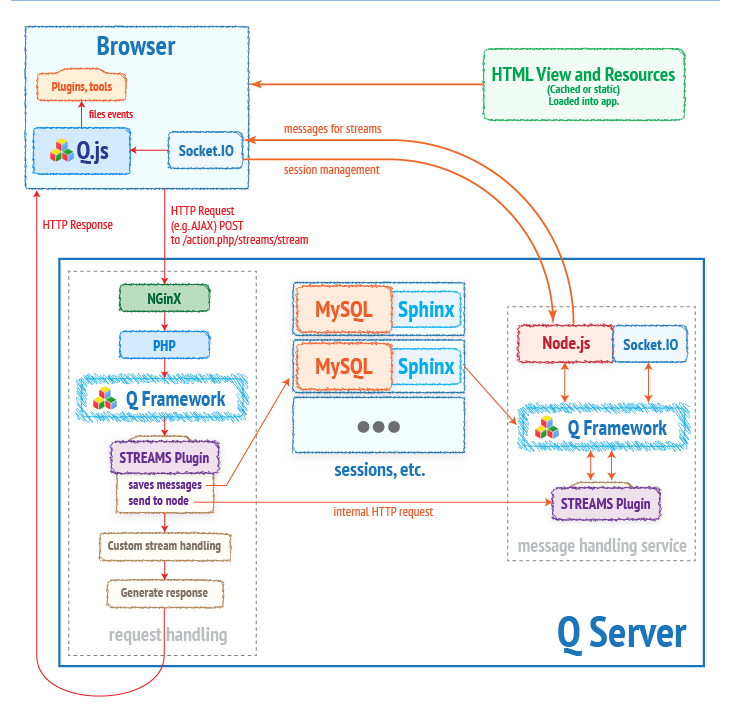
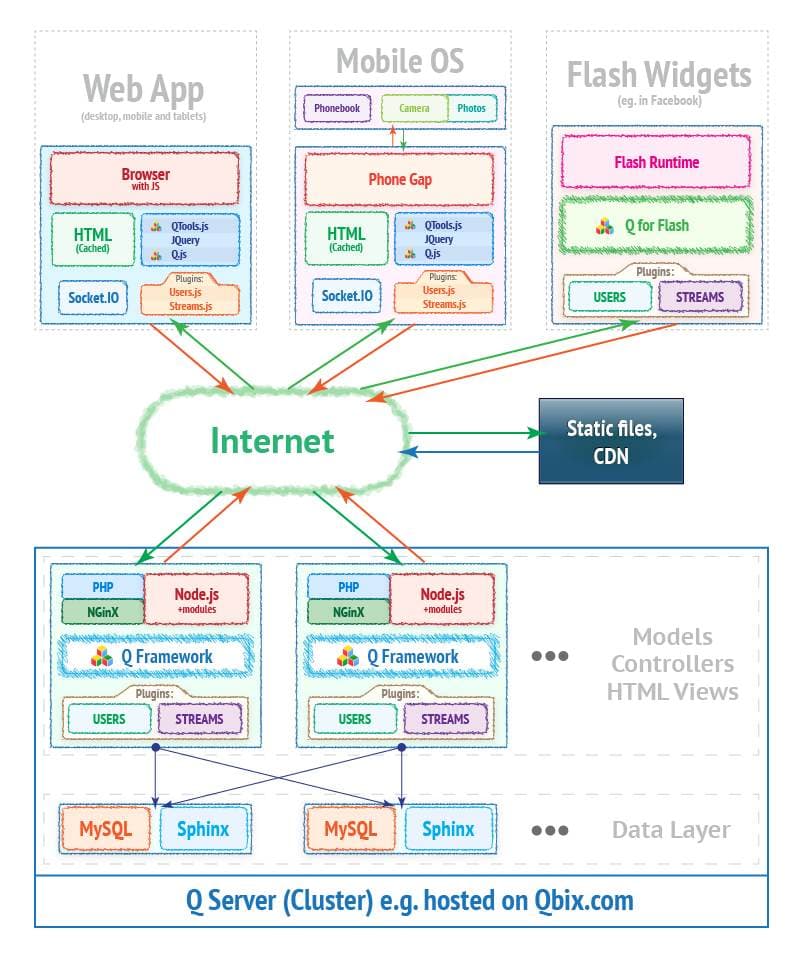
A creator finishes a recording on their own computer. They upload into the Safecloud using their browser. Before a single byte leaves their device, the browser encrypts it — split into chunks, each with its own cryptographic key derived from a master root key that never leaves the creator’s possession. The encrypted chunks are distributed across a network of Drops: browser tabs on ordinary computers running the Safecloud website. These can include the creator’s own machine, as well as people around the world that opened the browser tab and agreed to storing encrypted chunks (so they don’t know what they are storing).
To share the video, the creator shares a link. The decryption key travels in the URL hash — the part after the # — which browsers never transmit to servers. Only someone with the full link can watch. Encrypted content is not revealed to any server – not ours, not anyone’s.
How it works for a viewer
The viewer clicks the link. Their browser derives the decryption keys from the URL, requests the encrypted chunks from the network, decrypts them locally, and plays the video. The viewer pays via OCP claims — tiny signed authorizations that flow silently in the background. No blockchain popups. No waiting for confirmations. It feels exactly like any other streaming platform, except the money goes directly to the creator.
How the network stays honest
-
Drops store and serve encrypted chunks. They earn Safebux tokens for every chunk they deliver. If they go offline or serve corrupt data, their reliability score drops and they stop receiving traffic — and they can’t quickly exit because of the token transfer rate limit (more on this below).
-
Jets are servers that route requests between viewers and Drops, verify OCP payment claims, and ensure sufficient redundancy. They earn a small share of each payment for this coordination work.
-
The content creator earns the majority of every payment made to watch their content.
All payouts flow through Intercoin’s IncomeContract — the same battle-tested smart contract that Intercoin has used for years to distribute value across communities in any EVM token. No centralized entity controls this distribution. The splits are encoded in the contract.
What We Built: The Safebux Token Economy
Safebux (SAFEBUX) is the token that powers the network’s incentives. Here’s the complete economic picture in plain English.
For viewers
A viewer wants to watch a gated video. They can buy Binance Smart Chain tokens (BNB) through any service like MoonPay. They approve a small BNB payment — or have a pre-authorized spending line so it happens automatically. Behind the scenes, the platform acquires Safebux using that BNB and routes it as OCP payment claims to the content creator and infrastructure operators. The viewer just sees a video that starts playing. No wallet popups mid-stream. No blockchain jargon.
In milestone 5 when we roll everything out publicly, we also plan to deploy this same system of smart contracts on Ethereum Mainnet, Optimism, Arbitrum, and Base (Coinbase’s blockchain). This will allow people to have a choice of blockchain on which to make payments. Besides the blockchain’s native coin (such as ETH, BNB, etc.) they will be able to use USDT and USDC stablecoins if they are available on the site.
From that point on, they can exchange their BNB, USDT, USDC for fiat using their local exchanges in their country. In milestone 5, once we integrate with Circle Mint / Payouts API, we will be able to allow businesses in the US to withdraw money to their bank account.
For creators
As viewers watch, OCP claims accumulate. The creator can submit these claims to the blockchain at any time — permissionlessly, from anywhere in the world — and Intercoin’s IncomeContract distributes the Safebux to their wallet. The creator then redeems Safebux for BNB, USDC, USDT, or their preferred token at market rate. Direct to their wallet. No platform holds the money.
For Drop operators
Anyone can run a Drop node — a piece of software that stores and serves encrypted chunks. Drop operators earn Safebux for every chunk they serve. The more reliable and well-stocked their node, the more they earn. There’s no approval process. Anyone with a computer and an internet connection can participate.
The 10%-per-day transfer limit: why it matters
Safebux includes a deliberate design constraint: no more than 10% of a wallet’s balance can be transferred per day.
This is not an accident. It means:
- An operator who has been honest and accumulated a large Safebux balance has real skin in the game. They can’t dump and disappear overnight.
- A bad actor who tries to earn tokens by misbehaving — serving garbage data, going offline after claiming payments — faces a slow exit. The damage they can do is bounded and recoverable.
- The more Safebux someone holds, the greater their stake in the network’s health. This creates a proof-of-stake-like commitment without requiring a separate staking mechanism. Holding Safebux is itself the stake.
For honest participants, this is invisible. They accumulate tokens, redeem portions regularly, and reinvest in their infrastructure. For the network, it’s a continuous alignment mechanism.
What’s Live Right Now
-
 The Safebux token is deployed and functional on BSC testnet
-
The OpenClaiming contract is deployed on BSC testnet, verifying EIP-712 Payment claims and executing transfers
-
The complete upload → encrypt → store → stream → decrypt → play pipeline works end to end in our demo environment
-
OCP claim signing and verification works across browser, Node.js, and PHP with byte-identical results
-
Drop nodes earn Safebux as they serve chunks, with on-chain accounting
-
The IncomeContract distribution splits are wired and tested on testnet
-
open-source Safecloud codebase — browser encryption, Node.js routing, service worker HLS streaming, and PHP handlers — published at github.com/Safebots/Safecloud
Milestone 4 vs. Statement of Work
| Deliverable |
Status |
| Micropayment receipts on chain (signed OCP claims) |
Complete |
| Smart contracts for redemptions (Safebux ↔ BNB/USDC/USDT) |
Testnet |
| Reserve management and per-chunk pricing |
Complete |
| Fiat payout integration pathway |
 Architecture complete; KYC hookup in Milestone 5 Architecture complete; KYC hookup in Milestone 5 |
The fiat offramp (converting creator earnings to local bank currency for KYC’d users) is architecturally designed and the smart contract interfaces are ready. Connecting it to a payment processor is scoped for Milestone 5 alongside the mainnet launch.
Why Milestone 5 Is the Final Piece
Everything described above is now already developed. The cryptography is correct. The smart contracts have been deployed to testnets, and being tested before posting to mainnets. The storage network functions. The protocol is specified, implemented, and open-sourced for the world.
What Milestone 5 delivers will be the launch: turning a working system into something a creator can start earning from on day one, and a viewer can use without knowing any of the above exists.
Specifically:
-
BSC mainnet deployment of Safebux and OpenClaiming (currently testnet)
-
Seamless viewer UX — BNB → watch, with no visible blockchain interaction
-
Creator dashboard — earnings display, one-click Safebux redemption to any preferred token
-
Drop operator onboarding — simple UI to register a node and start earning
-
AI clip generation, translations, and social sharing per the Milestone 5 scope
-
Public launch — the platform opens globally to creators and viewers
The engine is built. Milestone 5 puts the body on the car and opens the factory doors.
We’re asking for Milestone 5 funding to take a functioning, documented, testnet-deployed, open-source system and turn it into the platform that creators — anywhere in the world, in any currency — can use to publish their work, own their audience, and get paid without asking anyone’s permission.
The OpenClaiming Protocol is published at openclaiming.org and github.com/OpenClaiming. Safecloud is open-source at github.com/Safebots/Safecloud. Intercoin’s suite of community smart contracts — including the IncomeContract powering all revenue distribution — is documented at community.intercoin.app.