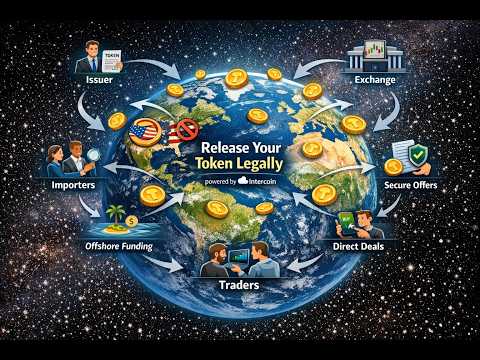
What if raising money, reaching your audience, and closing deals didn’t require platforms at all?
Intercoin is building a system where identity, communication, agreements, and payments connect directly between people. Each piece has been introduced separately—fundraising offshore, messaging tied to wallets, signed offers—but taken together they form something more complete: a way to coordinate value without relying on intermediaries.
Starting Where It’s Easier
Many founders run into friction immediately when attempting token sales. Regulatory complexity, especially in the United States, often turns early momentum into legal overhead.
A more practical approach is to begin where participation is already viable:
- raise funds outside the United States
- follow Regulation S safe harbor frameworks
- distribute tokens offshore first
Once tokens circulate internationally, markets begin forming organically. Over time, access broadens.
The important shift is not legal engineering, but sequencing:
start where participation is possible, then expand.
Reaching Token Holders Without Platforms
Once tokens are distributed, the next problem is communication.
Instead of relying on Telegram groups, Discord servers, or social platforms, Intercoin introduces a direct addressing model:
yoursite.com/contact/<wallet-address>
Anyone can attempt to send a message. Whether it gets through is determined by the recipient.
Messages can require:
- payment
- reputation
- endorsements
- prior relationships
The inbox becomes programmable. It is no longer a feed controlled by a platform, but a boundary defined by the user.
Importers and Market Flow
With communication detached from platforms, participation changes.
Some participants begin identifying opportunities in one region and introducing them into another. They observe token launches, track activity across communities, and connect interested parties.
These “importers” operate without permission or exclusivity. Their role is not to control access, but to move information.
Markets begin to form through these connections, the same way they do in the physical world: through awareness first, then exchange.
From Messages to Signed Offers
Messaging is useful, but negotiation still introduces ambiguity.
Instead of asking:
“Would you sell this for X?”
An offer can be expressed directly as signed data:
Offer:
- Asset: X
- Price: Y
- Expiration: T
- Signature: valid
The terms are explicit from the beginning. The recipient can evaluate and respond without guessing intent. Acceptance becomes a clear action rather than the result of extended negotiation.
Payments Without Friction or Volatility
Handling money is where most systems fall back to centralized platforms. Intercoin uses existing infrastructure in a way that avoids both friction and price instability.
- Stripe handles card payments, Apple Pay, and bank payouts
- Circle provides stablecoin minting and redemption at a fixed 1:1 rate
A user can pay with a credit card and receive value without managing wallets or exchanges. Vendors can receive payouts through familiar banking rails.
There is no need to route through volatile assets or automated market makers. A dollar in corresponds to a dollar out.
For scenarios where on-chain settlement is useful, blockchains such as Tempo can be used, but most interactions do not depend on it.
Safebox and Execution
Safebox enforces rules, permissions, and coordination logic while leaving custody with users.
Assets remain in user-controlled wallets. Actions require signatures from those wallets. The system verifies whether an action is allowed, but does not take possession of funds.
This allows:
- enforcement of transfer conditions
- verification of intent
- coordination without custody
The distinction is subtle but important: the system defines rules, users authorize execution.
Activation as the Entry Point
One of the harder problems in wallet-based systems is reaching users who have never interacted with your application.
Intercoin approaches this differently.
Tokens can be received by any address. Sending them requires activation.
If someone attempts to transfer without activating, the transaction fails with a message such as:
Enable transfers at mycommunity.com
At that moment, the user already has value and a reason to act. The first attempt to use the token becomes the point of onboarding.
No prior notification system is required.
Membership and Participation
This creates a boundary that functions as membership.
- receiving tokens is open
- using them actively requires participation
- sending is enabled after activation
Participation is defined by interaction with the system rather than by prior approval.
Vendors play a distinct role. They accept tokens and can convert them into other forms of value, including fiat payouts through Stripe or stablecoin redemption through Circle. This allows tokens to circulate internally while still connecting to external liquidity.
Putting It Together
The full system unfolds as a sequence:
- fundraising begins offshore using existing frameworks
- participants discover opportunities through networks of importers
- communication happens through wallet-linked endpoints
- offers are expressed as signed, verifiable data
- activation enables full participation
- value moves through stable payment rails, with optional on-chain settlement
Each component is straightforward. Their combination removes the need for a central coordinating platform.
What This Enables
The same structure extends beyond token sales.
Wherever there are:
- messages
- negotiations
- agreements
they can be replaced with explicit intent and verifiable execution.
This applies to:
- services
- hiring
- communities
- marketplaces
- access systems
The underlying pattern remains the same: identity, communication, and value are handled directly.
The Larger Shift
The change is not about decentralization as a feature. It is about removing assumptions.
- identity is no longer tied to platform accounts
- communication is no longer mediated by feeds
- agreements are no longer inferred from conversation
- value does not need to pass through intermediaries
Coordination becomes a direct interaction between participants, with software verifying conditions rather than controlling access.
Final Thought
Fundraising offshore, messaging without platforms, signed offers, gated activation, and stable payment rails may appear as separate ideas.
Together, they describe a simpler model:
people can find each other, communicate, and reach agreement without relying on a central platform.
Once that structure exists, everything built on top of it becomes optional rather than required.
If you’re looking to dive deeper, here are the articles:
-
 A Simpler Path to Token Crowdfunding Using Regulation S and Secondary Resales
A Simpler Path to Token Crowdfunding Using Regulation S and Secondary Resales -
A Neutral Messaging Layer for Token Holders and the Rise of Importers
A Simpler Path to Token Crowdfunding Using Regulation S and Secondary Resales - #2 by Gregory_Magarshak1 -
From Messaging to Executable Offers: How OpenClaiming Turns Communication Into Action
A Simpler Path to Token Crowdfunding Using Regulation S and Secondary Resales - #3 by Gregory_Magarshak1