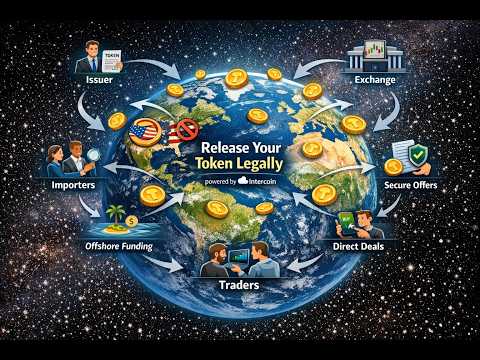
A Simpler Path to Token Crowdfunding Using Regulation S and Secondary Resales

This article explains a legally grounded pathway for issuing tokenized securities outside the United States, allowing them to “season,” and then enabling secondary market trading, including into the U.S., under existing exemptions.

The goal is not to invent a loophole—but to follow the structure Congress and the SEC already created.


1) The Core Idea

The pathway relies on three pillars:

  1. Offshore issuance under Regulation S
  2. A 40-day distribution compliance period (DCP)
  3. Secondary resales under Section 4(a)(1)

Each step has a specific statutory basis.


2) Step One — Offshore Issuance (Regulation S)

The offering begins under Regulation S, Rule 903.

The rule states:

An offer or sale is deemed offshore if:
(1) it is an offshore transaction
(2) no directed selling efforts are made in the United States
(3) category conditions are satisfied

This allows an issuer to:

  • sell tokens only to non-U.S. persons
  • avoid U.S. registration requirements
  • conduct a legitimate capital raise outside the U.S.

3) Who Counts as a “U.S. Person”?

Regulation S defines U.S. persons primarily by residency, not citizenship.

This includes:

  • individuals resident in the U.S.
  • U.S. entities
  • accounts held for U.S. persons

→ Non-U.S. participants can legally purchase, even if they are U.S. citizens living abroad.


4) Step Two — The 40-Day Compliance Period

After issuance, Regulation S imposes a Distribution Compliance Period (DCP).

From Rule 903:

Sales prior to the expiration of a 40-day distribution compliance period may not be made to a U.S. person

This applies (in this structure) because:

  • non-equity securities are treated as “debt securities” under §230.902
  • debt securities fall into categories with a 40-day DCP

5) How to Comply in Practice

During those 40 days:

  • no U.S. persons may acquire the tokens
  • “offering restrictions” must be implemented

The statute requires:

“offering restrictions are implemented”

This can be satisfied by:

  • contractual representations

  • legends

  • or:

    • smart contract restrictions

A hard on-chain lock (no transfers for 40 days):

→ is stricter than required
→ cleanly satisfies the DCP


6) What the 40 Days Actually Do

The purpose of the DCP is:

to ensure the securities “come to rest” outside the United States

In practical terms:

  • the initial distribution ends
  • securities become ordinary held assets

7) Step Three — Transition to Secondary Market

After the 40-day period:

  • Regulation S distribution restrictions expire
  • the securities can trade as secondary market instruments

At this point, resales do not need to rely on Regulation S.


8) The Key Exemption — Section 4(a)(1)

Secondary resales can rely on:

Section 4(a)(1) of the Securities Act

exempts transactions by persons other than an issuer, underwriter, or dealer

So if a person:

  • is not the issuer
  • is not a dealer
  • is not an underwriter

→ resale is exempt from registration


9) What Is an “Underwriter”?

An “underwriter” includes someone who:

  • purchases with a view to distribution, or
  • participates in a distribution

So the key question is:

Is the resale independent, or part of the original offering?


10) Why the 40-Day Period Matters

The DCP supports the conclusion that:

  • the original distribution has ended
  • later purchasers are entering a secondary market

This supports reliance on 4(a)(1).


11) Secondary Trading in Practice

After 40 days:

  • tokens can be bought on an open market
  • any participant can acquire them
  • those participants can resell them

If they meet the 4(a)(1) conditions:

→ resale is lawful


12) Offshore Liquidity (Rule 904)

For offshore trading, Regulation S also provides:

Rule 904

Allowing:

  • offshore resales
  • with no directed selling efforts into the U.S.

This enables:

→ early offshore liquidity (including AMMs)


13) Promotion and Disclosure

Promoters must comply with:

Section 17(b) of the Securities Act

They must disclose:

  • ownership of the security
  • compensation received

14) The “Arbitrage” Model

Putting it together:

  1. Tokens issued offshore

  2. Locked for 40 days

  3. Offshore trading begins

  4. After 40 days:

    • anyone can buy
    • resell into U.S. market
    • promote (with disclosure)

This resembles:

→ importing a good into a new market


15) Foreign vs U.S. Issuers (Key Distinction)

The pathway works for both foreign and U.S. issuers, but the statute routes them differently.


Foreign Issuer (Cleaner Path)

A non-reporting foreign issuer qualifies for Category 2:

“debt securities of… a non-reporting foreign issuer”

Result:

  • 40-day DCP
  • fewer structural constraints

U.S. Issuer (Category 3 Path)

A U.S. non-reporting issuer falls into Category 3:

applies to securities not eligible for Category 1 or 2

Still allows:

40-day DCP for debt securities

But adds:

  • explicit requirement to prevent improper transfers
  • requirement that issuer enforce restrictions

Why the Difference Matters

Category 3 assumes higher risk, so it requires:

issuer must refuse transfers not compliant with Regulation S


How Modern Systems Handle This

A smart contract that:

  • prevents all transfers for 40 days

→ satisfies Category 3 requirements

Result:

→ U.S. issuer becomes operationally similar to foreign issuer


16) Why This Is Simpler Than Reg CF

Compared to Regulation Crowdfunding:

  • no Form C
  • no funding portal
  • no investment limits
  • no ongoing reporting

Instead:

  • compliance is concentrated in:

    • offshore issuance
    • 40-day restriction

17) The One Critical Condition

Everything depends on:

secondary actors being independent of the issuer

If resellers are:

  • coordinated
  • compensated
  • part of a planned distribution

→ they may be treated as underwriters


18) Final Summary

Phase 1 — Issuance

  • Offshore sale (Rule 903)
  • No U.S. persons
  • No directed U.S. marketing

Phase 2 — Compliance Period

  • 40-day lock
  • Offering restrictions enforced

Phase 3 — Secondary Market

  • Open market trading
  • Resales under 4(a)(1)
  • Offshore trading under Rule 904

Phase 4 — Promotion

  • Independent actors may promote
  • Must disclose under 17(b)

19) Ensuring Purchasers Are Not “U.S. Persons”

A central requirement of Regulation S is that:

  • transactions occur offshore
  • purchasers are not U.S. persons

The statute relies on reasonable steps, not a single mandated method.


19.1 Using a KYC-Enabled Offshore Exchange

A strong approach is to conduct the sale through a non-U.S. exchange that:

  • performs KYC
  • excludes U.S. persons

Tokens are then:

  • distributed only to verified non-U.S. users
  • withdrawn into wallets subject to a 40-day lock

This supports:

  • offshore transaction requirement
  • non-U.S. participation

19.2 On-Chain Enforcement

A smart contract can:

  • enforce a complete transfer lock for 40 days

This ensures:

  • no transfers to U.S. persons during the DCP

19.3 Multi-Layer Location Controls

Additional safeguards include:

A. Advertising controls

  • target only non-U.S. regions
  • avoid U.S.-directed campaigns

B. IP filtering

  • block or flag U.S. IP addresses

C. User certification

  • require users to confirm non-U.S. status

D. Offshore infrastructure

  • host services outside the U.S.

19.4 Why Multiple Signals Matter

Regulators evaluate the totality of circumstances.

When these align:

  • exchange KYC
  • IP filtering
  • geo-targeted ads
  • user certification

→ strong evidence the offering is offshore


Final Takeaway

Regulation S does not require perfection—it requires:

reasonable steps to ensure offshore transactions and non-U.S. participation

By combining:

  • third-party compliance (exchange)
  • technical enforcement (smart contracts)
  • geographic controls (ads + access)

an issuer can build a system where:

→ the offshore nature of the offering is clear, consistent, and defensible under the statute


Bottom Line

Using existing statutory provisions:

  • Regulation S enables offshore issuance
  • The 40-day period ends the distribution phase
  • Section 4(a)(1) enables secondary trading

This framework works for:

  • foreign issuers (Category 2)
  • U.S. issuers (Category 3, with added safeguards)

When structured correctly:

→ tokenized securities can move from offshore issuance
→ to global secondary markets
→ without relying on traditional U.S. crowdfunding regime

A Neutral Messaging Layer for Token Holders (and the Rise of “Importers”)

Following up after:
A Simpler Path to Token Crowdfunding Using Regulation S and Secondary Resales


In the original article, we outlined a clean legal pathway:

  • Offshore issuance under Regulation S
  • A 40-day distribution compliance period
  • Secondary resales under Section 4(a)(1) of the Securities Act

The key principle was:

secondary market activity must emerge independently—not from the issuer

This article extends that idea in two directions:

  1. A neutral messaging layer for wallet holders
  2. The emergence of a new market role: independent “importers” (arbitrageurs)

1) The Problem: Discovery Without Intermediation

Once tokens are issued offshore:

  • buyers want access
  • sellers hold locked positions
  • information is fragmented

Traditional finance solves this with:

  • brokers
  • dealers
  • centralized exchanges

But here, we want:

market formation without intermediaries


2) The Solution: Address-to-Contact Infrastructure

The system is simple:

map a blockchain address → a communication channel

Examples:

  • wallet → email
  • wallet → Telegram
  • wallet → in-app inbox
  • wallet → webhook

Each mapping is:

  • user-controlled
  • cryptographically verified (signing a message)

What this is:

  • identity layer
  • messaging layer
  • ownership verification

What this is not:

  • a broker
  • a marketplace
  • a matching engine

3) How Communication Works

  1. A user registers contact info linked to a wallet
  2. Others can reach out
  3. The user decides whether to respond

No transactions occur on the platform.

No deals are arranged by the system.


4) The Emergence of “Importers”

With this infrastructure in place, a new role appears:

Importers (arbitrageurs)

These are independent actors who:

  • monitor offshore token offerings
  • analyze on-chain activity during the 40-day lock
  • identify promising projects
  • build an audience interested in those tokens

What Importers Do

During the 40-day period:

  • they do not buy directly from the issuer
  • they observe and analyze

They may:

  • publish research
  • discuss opportunities
  • build communities of potential buyers

At the same time:

  • they may reach out (via messaging layer) to holders
  • explore OTC transactions for when tokens unlock

5) After 40 Days: Market Activation

Once the distribution compliance period ends:

  • tokens unlock

  • holders can sell

  • importers can:

    • buy on open market
    • arrange OTC purchases
    • resell into their audience

This aligns with:

  • secondary market activity under 4(a)(1)
  • independent market participation

6) Legal Separation of Roles

This structure works because it maintains clear separation:


Offshore Issuer

Under Regulation S:

  • sells only to non-U.S. persons
  • avoids directed selling efforts into the U.S.

Critically:

→ the issuer does not market into the U.S.


Offshore Buyers (Primary Sale Participants)

  • purchase during Reg S offering
  • are subject to 40-day lock
  • do not sell into U.S. during that period

They are:

→ passive holders during distribution phase


Importers / Resellers

After 40 days:

  • purchase on open market or OTC
  • are independent actors
  • resell under Section 4(a)(1) of the Securities Act

They may:

  • promote
  • build audiences
  • create demand

7) Directed Selling Efforts: Who Is Responsible?

Regulation S restricts:

“directed selling efforts in the United States”

But this applies to:

  • the issuer
  • distributors
  • persons acting on their behalf

Key Insight

If importers are:

  • independent
  • not acting on behalf of issuer

Then:

→ their activities are not attributed to the issuer


8) The Role of the Messaging Layer

The communication system:

  • does not match buyers and sellers
  • does not arrange transactions
  • does not execute trades

It simply:

→ allows participants to find and contact each other

This preserves:

  • independence of market actors
  • separation from issuer

9) Is This a Marketplace?

No.

Because:

  • no transactions occur on the platform
  • no deals are structured
  • no liquidity is organized

It is:

infrastructure for communication


10) What About Disclosure (Section 17(b))?

Section 17(b) of the Securities Act requires disclosure when:

  • a person promotes a security
  • for compensation from an issuer or related party

Implication for Importers

If importers:

  • buy tokens independently
  • promote them to their audience
  • are not compensated by issuer

Then:

→ 17(b) is generally not triggered by issuer-related compensation

They are acting as:

→ market participants promoting their own positions


11) Why This System Works

This structure creates:

  • offshore issuance (Reg S)
  • enforced compliance period
  • independent secondary market
  • decentralized communication

Each layer is separate.

No single actor:

  • controls the flow
  • organizes distribution
  • intermediates transactions

12) A New Market Dynamic

This enables a new ecosystem:

  • issuers → raise capital offshore
  • holders → supply liquidity
  • importers → bridge markets
  • users → access opportunities

All connected through:

open communication, not centralized intermediation


13) Final Takeaway

The system works because it preserves a critical principle:

The issuer does not control or organize secondary distribution

Instead:

  • the market forms organically
  • participants act independently
  • communication is neutral

Bottom Line

By combining:

  • Regulation S issuance
  • 40-day compliance
  • 4(a)(1) secondary trading
  • and a neutral messaging layer

you create a system where:

→ global liquidity emerges without brokers, without portals, and without centralized control

This is a natural fit for our protocol:

From Messaging to Executable Offers: How OpenClaiming Turns Communication Into Action

In the previous article —
:point_right: A Simpler Path to Token Crowdfunding Using Regulation S and Secondary Resales

—we introduced a neutral messaging layer that allows token holders, importers, and market participants to communicate without intermediaries.

That system already enabled:

  • direct outreach between buyers and sellers
  • OTC discovery without exchanges
  • decentralized coordination across jurisdictions

But messaging alone still leaves one inefficiency:

Deals require back-and-forth negotiation.

This article introduces the next step:

Turning messages into executable, verifiable offers — using the OpenClaiming Protocol (OCP).


The Missing Piece: From Conversation to Commitment

Traditional markets rely on:

  • order books
  • brokers
  • exchanges
  • clearinghouses

Even decentralized systems often recreate these structures.

But blockchain enables something different:

A signed, portable intent that can be executed directly.

Instead of:

“I might buy your token for $X”

You can now express:

“I authorize a transaction to buy this token for $X, valid until time T”

This is not a listing.
This is not an order book entry.

It is:

A cryptographically signed capability.


What OpenClaiming Actually Adds

The OpenClaiming protocol already defines a general-purpose system for:

  • signed claims
  • time-bounded validity (nbf, exp)
  • parameter commitments (paramsHash)
  • multi-signature authorization
  • deferred or conditional execution

As shown in the official implementation, claims can authorize arbitrary contract calls, with validation and execution enforced on-chain.

This means:

An “offer” is simply a special case of a signed action.


Offers as First-Class Objects

An offer becomes:

  • a signed OpenClaim

  • describing:

    • what action can be taken
    • under what parameters
    • within what time window

Example (conceptually):

  • Buyer signs:

    • “Call contract X, method Y, with params Z”
    • valid until timestamp T

This transforms an offer into:

A verifiable, enforceable intent — not just a message


Why This Is Different From Exchanges

It is important to understand what this system is not:

It does not:

  • match buyers and sellers
  • maintain an order book
  • custody assets
  • execute trades automatically

Instead, it provides:

  • a communication layer
  • a commitment layer
  • an execution authorization layer

This distinction matters.

Because:

The system remains general-purpose infrastructure, not a marketplace.


Eliminating Negotiation Overhead

With executable offers:

Before

  1. Buyer sends message
  2. Seller replies
  3. Buyer adjusts
  4. Seller confirms
  5. Transaction executed

After

  1. Buyer sends signed offer

  2. Seller:

    • accepts → executes
    • ignores
    • counters

No ambiguity. No repeated negotiation.


Bilateral Agreement Without Intermediaries

The system can also support two-sided claims:

  • Buyer claim:

    • “I will buy under these terms”
  • Seller claim:

    • “I accept under these terms”

When both exist:

Execution can proceed deterministically.

This resembles contract formation, but without:

  • centralized enforcement
  • legal intermediaries
  • matching engines

Integration With the Messaging Layer

This builds directly on the previous article’s architecture.

Recall:

  • /contact/<address> endpoints
  • importer-driven discovery
  • decentralized communication

Now:

  • messages can carry:

    • signed executable offers
  • inboxes can:

    • filter offers
    • rank them
    • surface best opportunities

The result:

Messaging becomes economically meaningful.


Importers Become Deal Flow Engines

In the previous article, we introduced “importers”:

  • actors who discover offshore markets
  • analyze token activity
  • bring opportunities into the U.S.

With executable offers, importers gain a new role:

Before

  • identify sellers
  • negotiate manually
  • coordinate deals

After

  • broadcast signed offers
  • aggregate demand
  • route opportunities efficiently

They become:

Liquidity routers without custody or matching


Why This Matters for Regulation

The legal positioning remains consistent:

  • the system does not:

    • intermediate trades
    • take custody
    • match orders

Instead:

  • participants:

    • communicate
    • sign their own intents
    • execute independently

This aligns with broader trends:

  • blockchain reduces intermediaries
  • crowdfunding and tokenization enable direct participation
  • decentralized systems shift responsibility to participants ([Springer][1])

A General-Purpose Agreement Layer

The deeper insight is this:

OpenClaiming is not about tokens.

It is about:

  • agreements
  • authorization
  • execution

Offers are just one example.

The same system can handle:

  • payments
  • governance actions
  • service agreements
  • subscriptions
  • conditional workflows

This aligns with emerging research on “net-native agreement systems,” where software replaces layered institutional processes. ([arXiv][2])


Practical Examples

1. NFT Purchase Offer

  • buyer signs claim to buy NFT at price X
  • seller executes if acceptable

2. Token Block Trade

  • importer aggregates demand
  • sends executable offers to holders

3. Paid Access

  • user signs payment authorization
  • service executes upon validation

4. Governance Participation

  • members sign actions
  • quorum triggers execution

Why This Obviates “Back and Forth”

The key shift:

From negotiation → to pre-authorized execution

Instead of:

  • discussing possibilities

You exchange:

  • ready-to-execute intents

The Endgame: Intent-Based Markets

Putting it all together:

  1. Regulation S primary issuance
  2. Secondary resales via safe harbor
  3. Messaging layer for discovery
  4. OCP offers for execution

You get:

A fully decentralized pipeline from issuance → discovery → execution

Without:

  • exchanges
  • brokers
  • centralized marketplaces

Final Insight

The system you are building is not:

  • a crowdfunding platform
  • a messaging app
  • a marketplace

It is:

A universal intent and execution layer for the internet

Where:

  • identities are cryptographic
  • communication is programmable
  • agreements are signed
  • execution is deterministic

Bottom Line

Messaging connects people.
OpenClaiming lets them act, independently, by posting signed claims on blockchains.