The future is coming.
We’ve architected Intercloud as a decentralized system for storing, routing, and serving data — such as video, audio, and files — without relying on any single company, server, or authority. It is designed to be resilient, economically self-balancing, privacy-preserving, and compatible with today’s web and blockchain infrastructure.
- Layer 1 (Jets) deals only with hashes of data, making its design arguably more private than monero and z-cash, while simultaneously more general – being used for any data, not just money transactions.
- Layer 2 (Drops) deals with storing the data in encrypted chunks around the world, and handling the economics of storing and retrieving it. Anyone will be able to participate at-will using their browser, and anonymously earn cryptocurrency for providing storage and security to the network.
At a high level, Intercloud behaves like the atmosphere: Streams move through Jets and precipitate into Drops. That sentence is not just metaphorical, but gives a good intuition for how Intercloud is designed to work.
Layer 1: Routing and Coordination (Jets & Streams)
Jets are long-running nodes, typically on cloud hosting or always-on machines. They are responsible for coordination, not custody. Jets:
- Track the latest authoritative hash of a Stream
- Gossip updates with other Jets
- Route requests to where data is likely available
- Recruit Drops when content becomes popular
- Participate in dispute resolution
Jets are authoritative only about state (what the latest hash is), never about plaintext data.
A Stream represents a logical object: a video, a file, a live feed, or an evolving dataset. A Stream is identified by cryptographic hashes that change as content evolves. Forks are allowed and detectable; communities decide how to handle them.
Layer 2: Storage and Availability (Drops & Chunks)
Drops are lightweight participants around the world, often just browser tabs that people chose to keep open for a long time. Drops:
- Store encrypted chunks of data
- Serve chunks when requested
- Never see plaintext or decryption keys
- Can disappear at any time without harming the system
All data is encrypted before hashing. Encrypted chunks are organized into Merkle trees. Jets and Drops may claim to store a subtree, but must prove it on demand by serving randomly requested encrypted leaves.
By default, storage behaves like a predictive cache:
- Popular content spreads naturally
- Cold content decays over time
- Nothing is permanently stored unless someone pays for guarantees
This avoids forced hosting, reduces liability, and keeps costs aligned with demand.
Layer 3: Economics, Incentives, and Security
Payments and Trustlines
Most requests are paid. Payments can be made by:
- the requester,
- a community,
- or a sponsoring platform.
Requests carry trustlines — cryptographically verifiable promises of payment backed by locked funds. Small free or subsidized requests may exist, but larger transfers require proof of reliability.
Before granting high bandwidth, Jets issue random chunk challenges. Drops must serve random encrypted chunks they claim to store. Trust and payment ramp up only after successful proofs.
Claims, Stakes, and Accountability
Every Jet and Drop has a long-lived cryptographic key. This key is used to:
- sign storage claims,
- receive rewards,
- accumulate stake,
- and participate in disputes.
Rewards accumulate gradually and act as implicit stake. Withdrawals are rate-limited, meaning a node cannot behave well for months and then suddenly go rogue. The more a node earns, the more it has at risk.
If a node claims it has data but cannot serve it, its stake can be slashed.
Disputes
Disputes are rare and expensive by design. If a claim is challenged:
- Only the claimant may supply the disputed chunks
- A randomly selected group of Jets verifies the response
- Missing chunks result in slashing
- A small dispute fee prevents griefing
This enforces truthful claims without requiring centralized enforcement.
Cashing Out and EVM Compatibility
Intercloud is natively compatible with EVM-based blockchains and ERC-20 tokens.
Rewards earned by Jets and Drops are tracked off-chain but settled on-chain via Intercloud smart contracts, which enforce:
- withdrawal rate limits,
- slashing rules,
- trustline redemption,
- and stake accounting.
Because Intercloud relies only on standard ERC-20 interfaces, it works today on major EVM networks such as:
- Ethereum
- Arbitrum
- Optimism
- Base
- Polygon
- Avalanche (C-Chain)
- BNB Chain
Stablecoins like USDC, USDT, DAI, and others can be used directly. No new currency is required, and communities can choose which tokens they accept.
This makes Intercloud economically interoperable with existing DeFi, wallets, and exchanges.
Compatibility with the Existing Web
Intercloud integrates cleanly with today’s web stack:
- Browsers (via WebSockets and standard JavaScript)
- HTTP gateways
- CDNs and reverse proxies
- Existing video players and iframes
Drops can run entirely inside browser tabs. Jets can be deployed on standard cloud infrastructure. No specialized hardware or browser extensions are required.
This dramatically lowers adoption friction compared to systems that require custom clients or blockchains.
Privacy: Beyond Money, Beyond Existing Systems
Intercloud’s privacy model goes beyond payment anonymity.
- All data is encrypted before storage
- Hashes commit to encrypted content, not plaintext
- The same file can be encrypted multiple times, producing different ciphertexts
- Encrypted chunks can be rearranged, mixed, and re-served without revealing meaning
Encryption keys are arranged in a tree structure, allowing:
- selective access to parts of a Stream,
- previews or clips,
- subscriptions,
- revocable access,
- and remixing without copying raw data.
This enables data-level privacy, not just transaction privacy.
Unlike systems focused only on money, Intercloud protects what is stored and who can see which parts. In practice, this can be more private than privacy-focused cryptocurrencies, because observers cannot even tell whether two encrypted blobs represent the same underlying data.
Community-Level Governance Without Central Control
Intercloud does not enforce global policies. Instead, local communities can define their own rules.
For example:
- A community may collectively hold decryption keys
- Keys can be split or threshold-controlled
- Specific segments of a Stream (e.g. minutes of a video feed) can be decrypted
- Only under agreed conditions (such as a valid court order)
This allows lawful access without creating a global backdoor or central authority that can see all data.
Each community decides how much access to allow, how to govern keys, and how to comply with local laws — without imposing those rules on the entire network.
App Links as Secure Access Passes
Our App Store apps don’t send or store big files themselves. Instead, they send secure access links that act like digital passes. Each link contains just enough information for your device to unlock a specific part of a video or file — for example a clip, a chapter, or a time range. When you open a link, the app confirms you’re allowed to see it, fetches encrypted data from the network, checks that it’s authentic, and then decrypts it only on your device. Nothing else is revealed, and no server ever sees the unencrypted content.
Behind the scenes, it works like this:
- You open a link in the app or App Clip.
- The app confirms your access (membership, payment, or permission).
- Your device receives a small “key bundle” for just that part of the content.
- Encrypted data is downloaded from the network.
- Your device checks that the data hasn’t been altered.
- Only the allowed portion is decrypted locally.
- The content plays or displays instantly.
- More access can be unlocked later without re-uploading anything.
This means content can be shared safely, access can expire or be upgraded, and even if a link is shared, it only unlocks exactly what it was meant to — nothing more.
What This Achieves
- Decentralized routing and storage
- Real economic incentives instead of trust
- Compatibility with existing blockchains and web tech
- Stronger privacy than traditional content networks
- Selective, governed access instead of mass surveillance
- Graceful failure instead of catastrophic collapse
Intercloud does not try to control the weather. It builds an atmosphere where value, data, and incentives move naturally.
Streams move through Jets and precipitate into Drops — and no one controls the clouds.
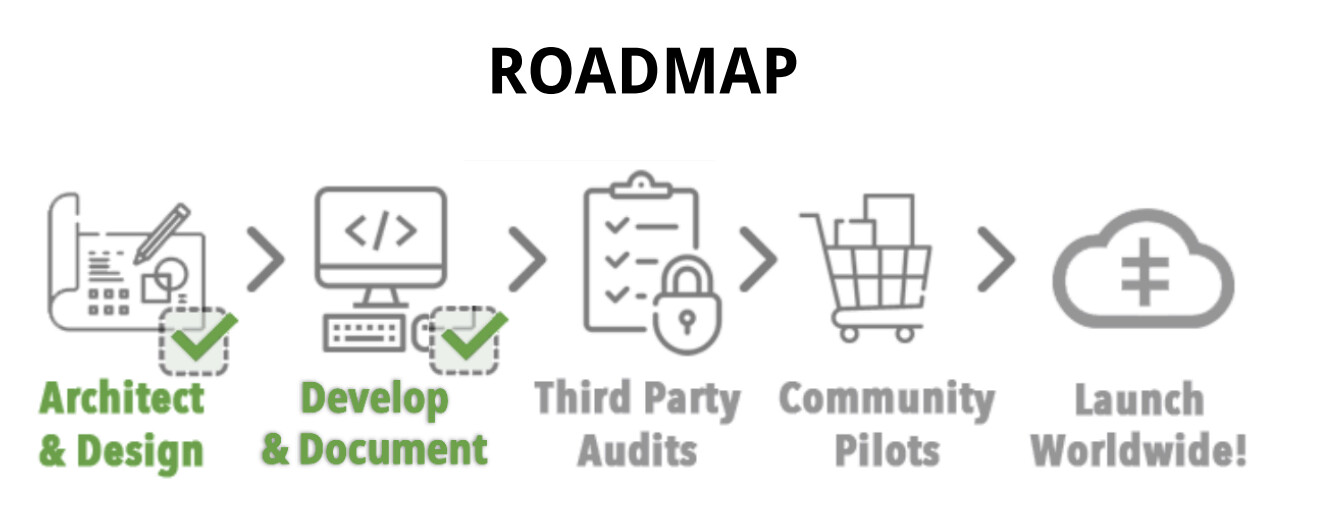
Like all our large projects, Intercloud is going through several stages. We’ve completed the Architecture, Documented it, and now are raising money finish Developing it. Get in touch if you want to get involved: